


7 Ways to Identify High-Quality Acrylic Powders
Quick Summary
High-quality acrylic powder has a narrow, even particle size, so it blends smoothly and forms a rounded bead that holds its shape. Test each new jar for dry flow, bead formation, self-leveling, and a hard, crack-free finish before using it on a client.
- Good powder flows freely off the brush with no chunks or dust clouds.
- A quality bead holds its rounded shape for several seconds without sagging.
- Run four pass-or-fail checks on every new jar before client use.
- Fine, even particles level smoothly; coarse grains make bead control harder.
- Store jars tightly closed in a cool, dry place and never pour leftovers back in.
Table of Contents
- What Acrylic Powder Does in the Acrylic System
- Acrylic Powder Consistency: The First Test of Quality
- How to Tell MMA Acrylic From Safer Formulas
- Best Acrylic Powder for Beginners and Common Defects to Troubleshoot
- Storing Your Acrylic Powder So It Lasts: Shelf Life and Contamination
- Stocking Trusted Powders at Nail Maxx for Your Next Service
- Frequently Asked Questions
What Acrylic Powder Does in the Acrylic System
Acrylic powder is the solid half of a two-part acrylic nail system. When it meets liquid monomer, the two react to form a hard, sculptable polymer that becomes the nail enhancement.
Here is the basic chemistry in plain terms. The liquid monomer softens the powder's polymer beads, and the mixture hardens as it cures. A good powder gives you a predictable working time, strong adhesion to the natural nail, and a finish that stays put.
- Powder: provides bulk, strength, and color
- Monomer: dissolves the bead surface so the mix can set
- Ratio: the balance of the two controls workability and cure speed
Because the powder does most of the structural work, its quality shows up in every service you perform.
Acrylic Powder Consistency: The First Test of Quality
Consistency is the fastest way to judge a powder before it touches a client's nail, but "feels nice" is not a test. A high-quality powder has a narrow, even particle-size distribution, so it blends smoothly, forms a clean bead, and behaves the same way from the first scoop to the last. Cheaper powders often contain uneven grains and fines that clump, resist mixing, and produce a bead that collapses or drags.
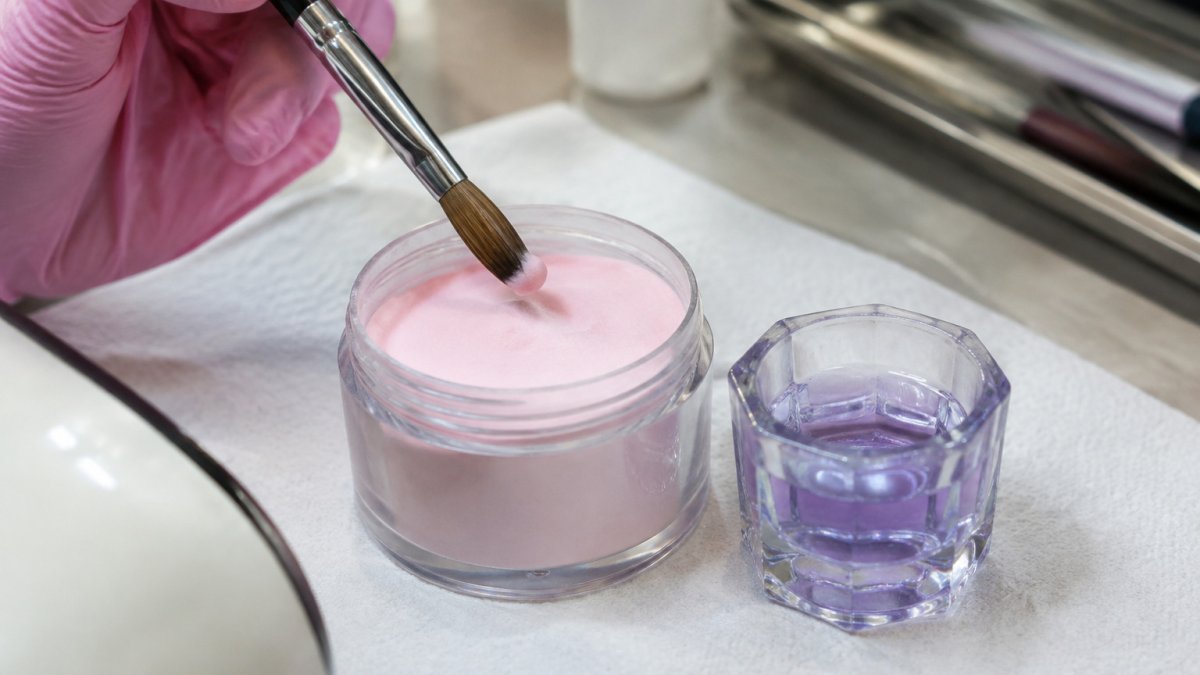
Look for these signs of consistent powder:
- Flows freely off the brush without chunks or dust clouds
- Holds a rounded bead shape for several seconds before it starts to settle
- Blends to a smooth, uniform color with no streaks or speckling
- Produces the same working time from one jar to the next
CND Sculpting Powders are designed for easy workability and a faster, full-bodied flow.
Particle size and bead control
Particle size affects how well your bead holds its shape. Fine particles produce a smooth, self-leveling bead that is easy to place. Coarse particles can make the bead grainy and harder to control at the cuticle. A powder with too many fines can also absorb monomer unevenly, which shows up as a bead that looks wet on top but is dry and crumbly underneath.
A common mistake is adding too much powder to a wet bead to "fix" it. This usually causes bubbles and uneven curing. Work with a small amount of powder and let the monomer do its job.
Measurable at-the-bench tests you can run
You do not need a lab to spot a weak powder, but you do need a repeatable protocol.
- Dry-flow check. Pour a small amount onto a clean dappen dish and tilt it. The powder should flow as a smooth ribbon with no visible lumps or grit. Fail if you see clumps larger than a pinhead or powder that sticks in a corner.
- Bead-formation check. Pick up one bead with a properly primed brush and hold it above the dish for a count of three. A quality powder holds a rounded, glossy bead that does not drip or sag. Fail if the bead runs off the brush or turns matte and crumbly within that count.
- Self-leveling check. Place the bead on a practice tip and tap it flat. A good powder levels to a smooth surface with minimal ridging. Fail if it leaves ridges you cannot pat out or if it pulls away at the edges.
- Set-and-finish check. Let the test bead cure fully, then inspect it. Pass if it is hard, clear or evenly colored, and free of cracks, cloudiness, or soft spots. Fail if it stays tacky, clouds, or chips at the edge when you file it.
Record the results on the jar or in a shop log. A powder that passes all four is likely ready for service; one that fails two or more is a candidate for return or for use only on practice tips.
The article describes four at-the-bench checks you can run on any new jar of powder before using it on a client.
| Check | What to look for | Fail if |
|---|---|---|
| Dry-flow | Smooth ribbon, no visible lumps | Clumps larger than a pinhead or powder sticking in a corner |
| Bead-formation | Rounded, glossy bead held for a count of three | Bead runs off the brush or turns matte and crumbly |
| Self-leveling | Taps flat to a smooth surface | Ridges that cannot be patted out or edges that pull away |
| Set-and-finish | Hard, clear or evenly colored, crack-free | Stays tacky, clouds, or chips when filed |
How to Tell MMA Acrylic From Safer Formulas
Some lower-cost acrylic products use methyl methacrylate (MMA) as the liquid.
When you compare products, check the labels and product listings for the monomer type.
- Look for clear labeling of the monomer and its composition
- Avoid unlabeled or "universal" products with no ingredient information
- Check whether the product is intended for professional use
- Ask your supplier for the safety data sheet if the listing is unclear
Best Acrylic Powder for Beginners and Common Defects to Troubleshoot
New technicians usually do best with a clear or natural powder that is forgiving to work with. Clear and pink shades are commonly chosen by new technicians. Colored or cover powders take more practice to blend without visible lines.
When a set does not go right, the problem usually traces back to one of three variables: the liquid-to-powder ratio, the prep, or product compatibility. Diagnose in that order before you blame the powder.
Start with the ratio
The ratio is the single biggest lever. A bead that is too wet (too much monomer) shrinks more as it cures, which pulls at the edges and causes lifting. A bead that is too dry (too much powder) is hard to pat out, traps air, and cures brittle. A medium-wet bead that looks glossy but does not run is a common starting point; adjust in small increments rather than dumping powder into a wet bead.
Defect-to-cause map
- Lifting at the edges or cuticle: usually oil or moisture on the nail, incomplete prep, an overly wet bead, or product applied too thick at the sidewalls. Fix prep first, then dry the bead slightly and build in thinner layers.
- Bubbles in the finished enhancement: from mixing too fast, overworking the bead, or applying too much powder at once. Stir slowly, pick up one bead at a time, and pat rather than stir.
- Clouding or a milky cast: often moisture in the powder or monomer, or a ratio that is off. Check that jars are sealed and that your monomer has not absorbed water; replace clumped or cloudy powder.
- Cracking or chipping: may happen when the enhancement is too thin, when the powder cures too hard and brittle, or when the product is incompatible with the monomer you are using. Build to a consistent thickness and keep powder and monomer from the same system.
- Uneven curing or soft spots: usually an off ratio or contaminated powder. Never pour unused powder back into the jar, and keep the lid closed between clients.
Compatibility check before you commit
Powder and monomer are a system, not interchangeable parts. A powder formulated for one monomer may set too fast, too slow, or cloudy with another. Before you switch brands, make one test bead with the exact powder-and-monomer pair you plan to use and run the set-and-finish check from the consistency section.
Fix the cause, not just the symptom. Thoroughly prep the nail, mix slowly, keep the ratio consistent, and build thickness in thin layers. A defect that repeats across multiple clients usually points to technique or a product mismatch, not to a single bad jar.
Storing Your Acrylic Powder So It Lasts: Shelf Life and Contamination
Acrylic powder can absorb moisture and pick up dust, which changes how it behaves. Store jars tightly closed in a cool, dry place away from direct sun.
Shelf life varies by product, so check the date printed on the packaging and follow the manufacturer's guidance. If a powder has clumped, changed color, or started to set slowly in the jar, replace it.
Contamination is also a risk in shared salon spaces. Use a clean brush for each client and avoid dipping a used brush back into the main container.
Stocking Trusted Powders at Nail Maxx for Your Next Service
Building a reliable supply means choosing powders you can trust for consistency and performance. Nail Maxx carries CND Sculpting Powders in several shades, including Intense Pink (Sheer) at $29.70 for 3.7 oz, Pure White (Opaque) at $29.70 for 3.7 oz, Clear at $111.00 for 32 oz, and Natural (Sheer) at $111.00 for 32 oz.
Browse the full acrylic powder range at Nail Maxx and pick the shade and size that fit your services.
Frequently Asked Questions
Which brand of acrylic powder is considered the best?
No single brand suits every technician, because the best powder depends on your liquid, your application style, and the service you perform. Judge candidates on the tests in this guide: smooth mixing, controllable beads, clean self-leveling, and a set that holds without lifting. CND Sculpting Powders are one option Nail Maxx stocks, available in Clear, Natural (Sheer), Intense Pink (Sheer), and Pure White (Opaque) at $29.70 for 3.7 oz or $111.00 for 32 oz. Test a small jar on a practice tip before committing to bulk stock.
How can you tell if acrylic powder is high quality?
A high-quality acrylic powder mixes into a uniform, slightly wet bead without clumping, holds its shape on the brush, and flows into a smooth, even layer. It should set at a predictable pace rather than skinning over too fast or staying tacky. Consistency between jars matters as much as any single test.
Do acrylic powders go bad?
Yes. Acrylic powder can absorb moisture and contaminants over time, which causes clumping, poor flow, and weaker adhesion. Keep containers tightly sealed, store them away from heat and humidity, and avoid pouring unused powder back into the jar. Most manufacturers print an expiration or lot date, and any powder that clumps despite proper storage should be discarded rather than used on clients.
Nail Maxx CND Sculpting Powder Prices
